Renowned Georgian Mountaineers

MIKHEIL KHERGIANI, GURAM TIKANADZE, AND BIDZINA GUJABIDZE
Mikheil Khergiani – “The Tiger of the Rocks”
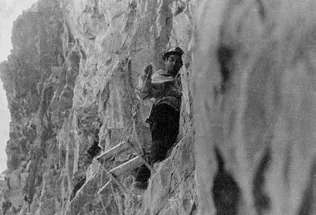
Mikheil Khergiani, famously known as the “Tiger of the Rocks,” was a legendary Georgian mountaineer renowned for his exceptional climbing skills. Born on March 20, 1932, in Mestia, Svaneti, Khergiani grew up in a family of mountaineers. From an early age, he listened to captivating stories about the mountains from his father, Besarion Khergiani, which deeply influenced his passion for climbing. His remarkable abilities soon earned him widespread fame, both nationally and internationally. A defining moment in Khergiani’s career occurred in 1964 when he was invited to England to compete with local climbers. During one of the competitions, Queen Elizabeth II noticed Khergiani scaling the rocks in tricounis—special climbing boots with soles resembling a tiger’s paw—and asked, “Who is that man climbing like a tiger on the rocks?” This remark led to his enduring nickname, “The Tiger of the Rocks.” Khergiani was a seven-time champion of the USSR mountaineering championships. He famously refused to participate in an international competition until his name was announced alongside Georgia’s, a bold move that caused him trouble with Soviet authorities and led to a temporary disqualification. Despite the obstacles, Khergiani remained committed to his craft, dedicating himself to mountaineering and participating in numerous rescue missions that saved many lives. Tragically, Khergiani lost his life in 1969 at the age of 37 while climbing the 700-meter wall of Mount Su Alto in the Italian Alps. A rockfall severed his rope, leading to his fatal fall. Today, Khergiani’s house in Mestia has been transformed into a museum that commemorates his life and contributions to Georgian mountaineering, as well as the rich cultural history of Svaneti.
Guram Tikanadze – The Mountaineer and Photographer
“Mountaineers are often asked: what draws us to the mountains? To us, such questions seem irrelevant, so we often leave them unanswered. We know well that every stone and snowflake hides danger. Thunderstorms and snow threaten the slopes, while the scorching sun causes avalanches and rockslides. There’s always something new, something to keep you alert, something to challenge you. We feel more connected to the mountains and ice than to the lowlands and seas.”
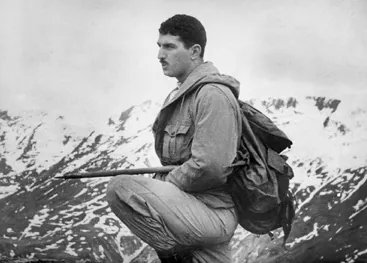
These words by Guram Tikanadze reflect his deep understanding of the dangers inherent in mountaineering, yet they also reveal his unwavering dedication to the peaks. Born on September 12, 1932, Tikanadze pursued a career in geology but devoted much of his life to climbing. During his brief career, he successfully ascended approximately 40 peaks. His first significant climb was Mount Spartak in 1952, and by 1957, he was regularly conquering fifth-category peaks. In 1958, during an expedition to the main ridge of the Central Caucasus, Tikanadze scaled 14 out of 16 peaks, earning a silver medal from the USSR.
Beyond mountaineering, Tikanadze had a profound interest in photography, which began during his school years. He made significant contributions to Georgian photography, with his work frequently featured in both domestic and international publications. In 1959, he began working as a photojournalist for the magazine Drosha and received an award at the Vienna International Festival—the first international recognition in the history of Georgian photography.
Among his most notable photographs are “Sweet Melon”, “Sunrise in the Mountains”, “Tetnuldi – Bride of Svaneti”, “Ushba”, and “Shkhara”. In August 1963, Tikanadze led a sports group to successfully climb Mount Tetnuldi. On August 21, they reached the summit of Shkhara. Tragically, on August 27, while descending the mountain, Tikanadze was killed in a fall. Today, his legacy is preserved in a museum located in Latali, Svaneti.
Bidzina Gujabidze – Twice a Conqueror of Everest
Bidzina Gujabidze, born on January 20, 1960, in the mountainous village of Chochkhati-Khoret in the Lanchkhuti region, was captivated by the mountains from a young age. The awe-inspiring peaks surrounding his childhood home inspired him to pursue a career in geology. He fulfilled this ambition by graduating from the Faculty of Mining Geology at the Georgian Technical University in 1982. His mountaineering career began in 1979, when he participated in an alpine expedition upon the recommendation of a fellow student. Under the leadership of Lado Gurchiani, the group successfully climbed Mount Gori in the Khde Valley (Kazbegi region). From that moment, Gujabidze’s life became inseparably tied to the mountains. He describes mountaineering as a personal challenge, a constant competition with oneself. Over the years, Gujabidze has climbed numerous prominent peaks, including multiple ascents of Ushba, Kazbegi, and Mount Everest. He is a two-time recipient of the prestigious Snow Leopard title, a holder of the Order of Honor and the Vakhtang Gorgasali III Degree Medal, and a recipient of an official certificate from the government of Nepal. One of his most memorable achievements was his 1984 expedition to Mars Peak, where he reached an altitude of 6,723 meters at the age of 24, marking his first ascent to such a significant height. Gujabidze has climbed Mount Everest twice, describing the experience of reaching its 8,848-meter summit as unmatched. He regards conquering Everest as a major athletic accomplishment and a symbol of personal victory. Although he dreams of climbing the Trango Towers in Pakistan, he acknowledges that fulfilling this dream may no longer be possible.
Naples meets Tbilisi, in the name of art, culture and solidarity. The prestigious Di Meo Calendar, promoted and produced every year by the ‘Di Meo vini ad arte’ Association, under the patronage of the Italian Presidency of the Council of Ministers, is now in its 23rd edition, this year also with the support of the Georgian Chanting Foundation.
The presentation of the Di Meo Calendar is now a much-awaited international event. It is meant to be a testimony to the values that inspire the Association and an opportunity, even in a difficult and painful historical period such as the present, to reaffirm the importance of dialogue between peoples and between different cultures. The overall sense of this initiative and its deeper meaning lie in the links woven between different cultural spheres, to contribute to a better mutual understanding.
‘I chose Tbilisi for the 2025 Calendar,’ says Generoso di Meo, the volcanic founder of the Association, ‘whose
ve sa do lu ma me gi
culture and civilisation has been neglected for many years by the West, which baselessly merged all the federated republics of the Soviet Union into an idea of “Russia”, neglecting their specificity and impressive variety and diversity, transfused into the literature, music and other artistic expressions of these peoples. A capital that has been, since the 5th century, a melting pot of the most diverse civilisations between East and West’.
House Museum of Ilia Chavchavadze
Once again this year, the photos of Massimo Listri (http://www.massimolistri.com), who signed the calendar from 2013, will offer a visual reading of the city. With his gaze, he has been able to give it an unexpected light, restoring in the calendar all the narrative power of the Georgian capital, a symbol of art, culture and dialogue between peoples. Not only photos, but also tales and stories that tell of the points of contact between the city of Naples and Tbilisi. Thanks to the critical contribution of renowned scholars, the Calendar will investigate the most significant correspondences between Naples and Tbilisi: the Siren and the Panther. The symbol of the birth of Naples is, in fact, the siren Parthenope, and its inhabitants are still referred to as Parthenopeans, while Georgians have long identified with the myth of Tariel, at the centre of the beautiful poem ‘The Panther-skinned Knight’ by Šota Rustaveli, a national poet who lived in the 12th (century, equivalent to our Dante.
Numerous significant historical events link Naples and Campania to Georgia. An important point of contact is represented by wine, as recent archaeological excavations have also ascertained. It is no coincidence that the word for wine in western languages derives from the Georgian or, as linguists say, proto-Kartvelian, yvino. But there are many traditions that make the relationship between Naples and Tbilisi alive: the cult of love, the language of feelings, the propensity for emotion, the vocation for hospitality, the passion for poetry and conviviality, the love of football and the of the great champion Kvaratskhelia, whose contribution was decisive in
ve sa do lu ma me gi
Opera State Theatre
Napoli’s winning of the third Scudetto; and again, the common art of leavening (pizza and khachapuri), the funicular railway in the two cities, the positioning of Tbilisi and Naples on the 41 parallel. In addition, the first chair of Georgian Language and Literature in Europe was established at the Orientale University in Naples.
In the study conducted by Generoso di Meo, it also emerged how much the two cities are united by elements of common culture: it is no coincidence that the Neapolitan nativity scene features, among the traditional characters, that of the Georgian woman, just as, for both, the passion for music is strong. If the tradition of Georgian polyphonic singing is the first case of ‘intangible heritage of humanity’ accepted by UNESCO, Georgia is also the land of great opera singers who have performed at the San Carlo theatre and of young talents in whom the Neapolitan Opera House has invested, promoting their growth through its Singing Academy.
The Di Meo 2025 Calendar, produced in 5000 copies, will be presented to the press and an important parterre of international cultural and business leaders in Tbilisi.
After having presented past editions in prestigious venues (such as the Royal Academy of Arts in London, the State Historical Museum in Moscow, the National Museum in Warsaw, the Kunsthistorisches Museum in Vienna, the Ajuda Royal Palace in Lisbon, the Çırağan Palace in Istanbul, the Palace of Serbia in Belgrade, the Alcázar in Seville, the Municipal House in Prague), the gala presentation of the Calendar will be held in October 2024 in the Mtatsminda Palace, which can be reached by the scenic Tbilisi funicular. The texts in the calendar were edited by Angela Catello, Cesare Cunaccia, Michele De Lucchi, Dante Stefano Del Vecchio, Dinko Fabris, Michele Fatica, Andrea Forlani, Patrizia Licini de Romagnoli, Luigi Magarotto, Elisabetta Moro, Veronique Murat, Gaga Shurgaia and Pino Taormina.
Napoli Tbilisi